The Guardian Review of Portrait of a Lady
W lid a thrillingly versatile film-maker Céline Sciamma has proved to be. Having made an arthouse splash with the Euro-hits Water Lilies and Tomboy, she wrote and directed Girlhood (Bande de filles), a breathtaking portrait of modern "banlieue life" that completed her "accidental trilogy of youth". Her impressive screenplay credits include Claude Barras's My Life as a Courgette, a tenderly empathetic, French-Swiss stop-motility masterpiece that earned an Oscar nomination for its vividly resilient depiction of children in intendance. In each of these very different projects, Sciamma has struck an accessible chord past focusing tightly on specifics, finding the primal to universal appeal in the unique, tiny details of each story and character.
For her quaternary characteristic as writer-director, Sciamma ventures to a new earth of the late 18th century. We first meet Marianne (Noémie Merlant, star of Marie-Castille Mention-Schaar'due south Le ciel attendra) educational activity life study in Paris to art students, 1 of whom stumbles upon her titular painting. An arresting night-time paradigm of a woman whose dress is hemmed with flames, this painting provides a portal to the by. Through information technology, we are transported back to Marianne's stormy, bounding main-leap arrival at a remote Brittany residence where she is to paint quondam convent girl Héloïse (H2o Lilies alumnus Adèle Haenel). Héloïse's countess mother (played with imperious fragility by Valeria Golino) intends to send the painting to a Milanese nobleman; if he approves, her girl volition be wed and they will both be transported to a new life. But Héloïse has no desire to be married, and has already defeated ane painter who left without ever seeing her face up. And then Marianne, who has been brought here on the pretext of being a chaperone and companion, must study and paint her discipline in secret, looking without appearing to wait…
That this deception should soon be revealed is no surprise – the electric tension between the pair prevents either of them from keeping secrets for long. Yet when confronted with Marianne's first attempt to capture her likeness, Héloïse is appalled. "Is that how you see me?" she demands, stunned less by Marianne'southward deceit than by the lack of life – of "presence" – in her picture. "The fact it isn't close to me, that I can understand," she says bitterly. "But I find it sad it isn't close to you."
What follows is an intellectually erotic study of ability and passion in which observed becomes observer, authored becomes writer, returning time and again to a fundamental question: "If yous look at me, who practice I await at?" It'southward a question that reverberates throughout Sciamma's playfully literate film, which rightly won the Cannes prize for all-time screenplay last twelvemonth. We hear it echoed in a historically accurate discussion of the way the art earth keeps women in their identify by proscribing the subjects of their gaze, their research.
More significantly, it informs an ongoing debate about the myth of Orpheus and Eurydice that runs similar a silvery thread through the drama. "He doesn't brand the lover'due south option, only the poet'south," Marianne says of Orpheus and his fateful decision to wait back as he ascends from the underworld. But perhaps that decision was not his to brand? Could Eurydice be the author of her own fate, the commander of his gaze?
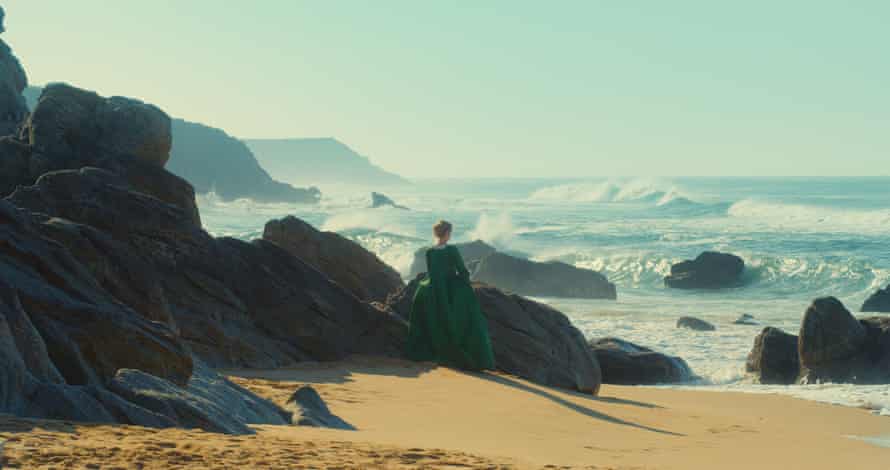
Digitally filmed in tactile, painterly hues by Claire Mathon, who did such shimmering work on Mati Diop'south Atlantics, Portrait of a Lady on Burn (the French title uses the less Jamesian "jeune fille") seamlessly intertwines themes of honey and politics, representation and reality. At times it plays like a breathless romance, trembling with passionate anticipation. Elsewhere, information technology seems closer to a sociopolitical treatise, what Sciamma has chosen "a manifesto virtually the female gaze". Ghostly images of Héloïse in her wedding dress lend a quasi-gothic edge, and there'southward something of the Brontës in the cliffside walks she embraces with abandon. Yet Sciamma is careful to continue such heightened emotions rooted in the firm soil of social realism. A subplot most young maid Sophie (Luàna Bajrami) dealing with an unwanted pregnancy finds Sciamma at her most quietly radical, non merely confronting but also depicting a taboo subject field and its representation, refusing to wait away, finding forcefulness in sorority.
Musically, Sciamma keeps things sparse and diegetic, mirroring Héloïse's cloistral feel (she longs to hear an orchestra), emphasising her silenced sense of imprisonment. All the more significant, then, that a signature scene bursts into vibrant song – a chorus of alive vocals and handclaps that momentarily lifts the film into an ecstatically uncanny reverie, equally mesmerisingly magical as annihilation I can think seeing on screen.
Source: https://www.theguardian.com/film/2020/mar/01/portrait-of-a-lady-on-fire-review-celine-sciamma

Postar um comentário for "The Guardian Review of Portrait of a Lady"