Nippon Hand Painted Oblong Serving Plate With 6 Small Dishes Art Deco Style
New Porcelain Marked Nippon
Since the mid-1990s there have been a wide number of faked Nippon marks appearing on new porcelain.
The beginning imitation marks of the 1980s were on blanks with decorations unlike that of original Nihon and were relatively like shooting fish in a barrel to identify. Recent fakes have improved tremendously and have many of the features of originals such every bit heavy raised gold, pastel colors and very accurate copies of original marks.
Background
The manufacture and decoration of pottery and porcelain has been a Japanese tradition for hundreds of years. Japanese porcelain has been commercially imported into the Us from the mid-19th century. By the turn of the century, large quantities of Japanese porcelain were beingness imported and sold throughout the U. Southward. The amount increased dramatically when WW I cutting off the U.Southward. from European porcelain factories.
One of the reasons Japanese porcelain was pop in the U.Southward. was because it was usually less expensive than porcelain from Europe or England. The low cost was non based on depression quality, however. It was due to Japanese workers being paid very trivial for the fourth dimension and skill they brought to their work.
Japanese porcelain made for export to the U.s.a. from 1891 to 1921 is called "Nippon Porcelain" because the word "Nihon" was on each piece. The word "Nippon" was required by the McKinley Tariff Act of 1890. This law stated that all manufactured goods imported to the United States be marked with the state of origin. Since "Nippon" was the Japanese word for the country of Nippon, porcelain made there for the U.S. market was marked "Nippon" to comply with the new police force. American trade officials accepted "Nippon" as the name of the country of origin until 1921. At that time, it was ruled that "Japan" was a Japanese word. Since the police force required the country of origin to be an English language discussion, the apply of "Nippon" was forbidden from 1921 on.
The period betwixt the passage of the McKinley Act in 1890 and the English word ruling in 1921 is the simply fourth dimension "Nippon" appeared in authentic marks. For years, this knowledge was an easy dominion of pollex collectors used to their do good. Whatever marker with "Japan" had to exist made before 1921 when the word was banned from U.S. imports. This rule held true until the early 1980s when new porcelain began appearing with marks containing the discussion "Japan". Did the law modify?
Current Trade Law
No, the McKinley Human activity did non change; nor was it interpreted differently. Goods imported into the U.Southward. still must be marked with the English name of the country of origin. However, new porcelain, imported from Taiwan for example, meets all current U.S. Customs requirements with a simple "Made in Taiwan" paper label. The appearance of other names on a slice, such as Nippon or R.S. Prussia, Limoges, etc., is not illegal.
Why? The bulk of words collectors associate with age or quality--similar Nihon, Prussia, Limoges, etc.--are more often than not place names for countries or regions that no longer exist. For U.S. Custom'southward purposes, one-time place names are ignored as long as the nowadays day country of origin is stated. In other words, a confusing mark including the word Nippon is not illegal equally long as the piece is too marked "Made in Taiwan (or China, Indonesia, etc.)". Unfortunately most "Made in...." country of origin markings are ordinarily removable paper stickers. New marks with Nippon and other confusing words and symbols are usually under coat and are not removable. Persons who want to misrepresent a new slice just remove the country of origin label. Information technology is and then up to the heir-apparent to detect the often subtle differences between new and old marks.
Detecting new and old
Detecting fake marks from memory alone can be hard. No i rule can exist used to detect all the new marks. What may be an indication of a simulated in one mark, may not be of assist when examining another mark. Almost marks need to be examined on a case by case basis. Apply the guidelines for new and old only to the specific marking beingness discussed. Study and familiarize yourself with the key features of original marks listed by the photographs and illustrations in this article. Don't exist misled by big areas of raised gold or what appears to exist genuine old colors and quondam decorations. The overall advent of the latest reproductions is condign more and more than similar Japan originals.
The differences between new and old marks appear beneath. A summary chart of new and old marks appears at the end.
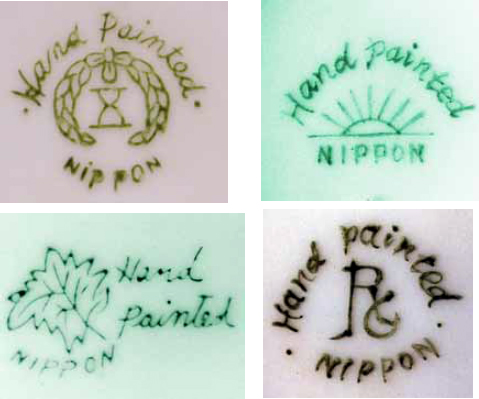
Fig. one A sample of new Nippon marks. All are copied from 18-carat pre-1921 marks.
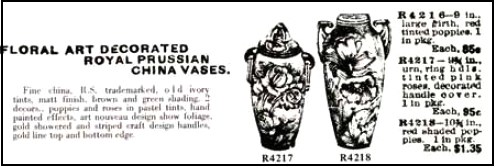
Fig. 2 RS (Reinhold Schegelmilch) Prussia vases as shown in 1914 Butler Bros. catalog. Vases are nine" to 10 1/4" high; price 85 cents to $1.35 each. Compare to similar 9" Nippon vases shown in Fig. 3 which are $iv.l per dozen or 38 cents each which is well-nigh only half the cost of the European porcelain.
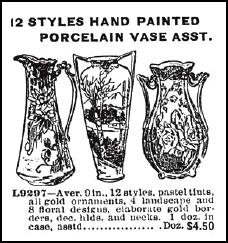
Fig. 3 Nihon 9" vases from Butler Bros. itemize, 1913. Price $iv.50 per dozen

Fig. 4
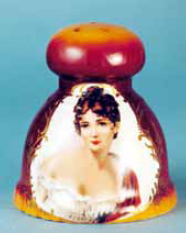
Fig. 5 Many place names associated with age or quality are permanently marked on new porcelain made in Taiwan, Nihon, Bharat, etc., The new hatpin holder in Fig. 5 was made in Japan and originally had a "Fabricated in Nihon" paper label. However, it is permanently marked with the confusing new Limoges mark in Fig. iv.
New wreath marks
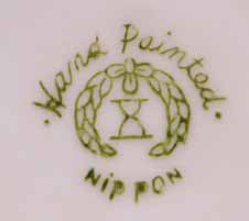
Fig. 6 New wreath: mark (A) -- Wreath turned upside downwards; an hour glass was never used in old mark.
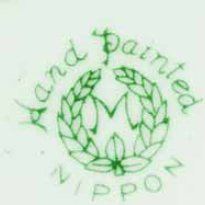
Fig. 7 New weath: marker (B) -- Wreath is closed at height; no stem on 3-leaved figure at base of wreath.
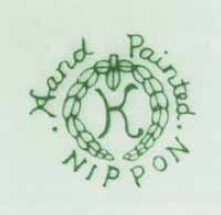
Fig. eight New wreath: mark (C) -- Wreath turned upside down; alphabetic character "K" was never used in onetime mark.
Original wreath
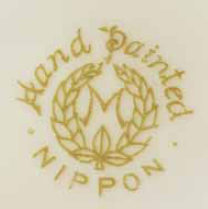
Fig. nine Original mark -- The wreath is open up at the top. All lines are quite solid and distinct.
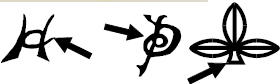
Details in original wreath marks
At that place are distinct decorative flourishes in the letters H and P of Hand Painted. The three leaf figure at the base of the wreath should accept a stem.
New maple leafage mark
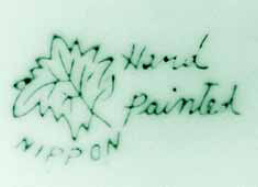
Fig. 10 The leafage in the new mark is nigh 1/ii" wide. The leaf itself is poorly shaped and the lines tend to be cleaved and weak.
Original maple leaf mark
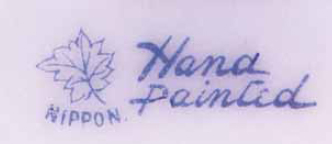
Fig. 11 The leaf in the one-time marking is only about i/4" wide. All lines in the onetime mark are solid and heavy.
New ascent sun marks

Fig. 12 New rising lord's day: mark (A) There is a white space between the jagged edge of the rays and the solid torso of the sunday.
(Sample unavailable for photographing.)
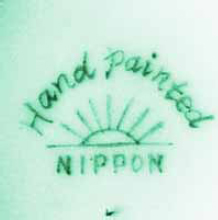
Fig. 13 New rise sun: mark (B) The semi-circumvolve of the dominicus is shown in outline (hollow). Rays are straight lines.
Original mark
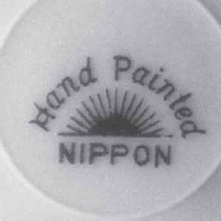
Fig. 14 Original rising sun mark: Solid rays extend from the solid trunk of the sun.
New RC mark
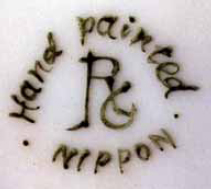
Fig. xv New RC mark: New marker entirely light-green. R C poorly formed; RC barely recognizable as English letters. Printing is weak.
Original RC marking
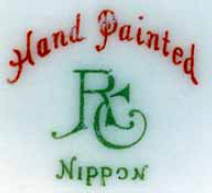
Fig. sixteen One-time RC mark: The words "Hand Painted" are in red; "RC" and "Nihon" appear in greenish. Letters RC are distinct.
New spoke mark
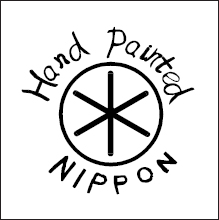
Fig. 17 New spoke mark: The words "Hand Painted" grade a semicircle at the summit.
(Sample unavailable for photographing)
Old spoke mark
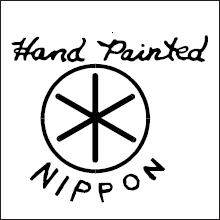
Fig. 18 Former Spoke mark: The words "Hand Painted" are set in a straight horizontal line at the tiptop.
(Sample unavailable for photographing).
Examples of new pieces with new Nippon marks
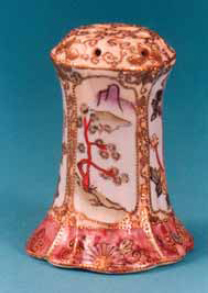
Fig. 19 four" hatpin holder with new mode B wreath mark. Decorated with raised gold similar to original decorations.
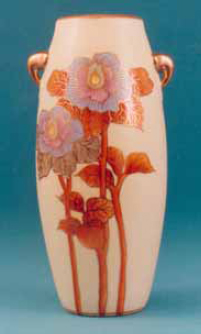
Fig. twenty 8" vase with new RC mark. The same decoration appears on the bowl in Fig. 24 beneath. No specific mark is found on whatever specific shape or any particular ornamentation. Any new marking can appear on nearly any new shape.
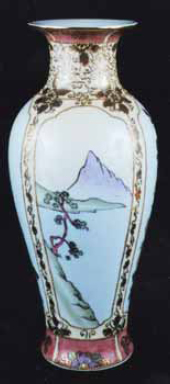
Fig. 21
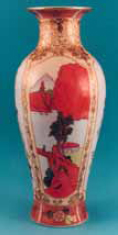
Fig. 22
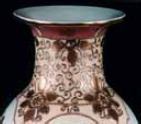
Fig. 23
Figs. 21-23 Vase in Fig. 21 is 12" high; has new rising sun mark. Decoration includes utilise of raised gold shown in close up in Fig. 23 to a higher place. Contrary side of vase appears in Fig. 22.
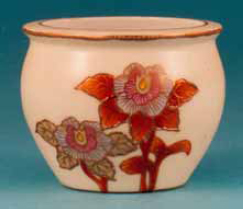
Fig. 24 Bowl higher up is 3 10 ii one/ii"; new ascent sun mark. Same decoration as vase in Fig. 20 with new RC mark.
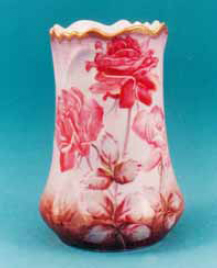
Fig. 25 half dozen" vase with new maple leaf mark
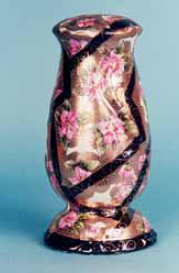
Fig. 26 viii" vase with new spoke marker.
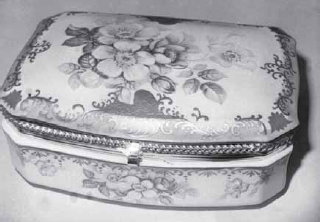
Fig. 27 A eight" porcelain box with metal hinges and trim. Marked with new K in wreath marking.
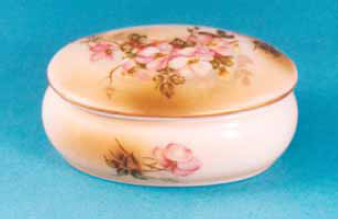
Fig. 28 A iv" two-piece covered box marked with hour glass in wreath mark.
Summary of new Nippon marks
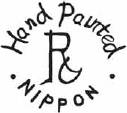
The entire mark is light-green. The R and C do non appear as singled-out letters. Lines forming the mark are very weak and thin.
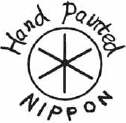
"Hand Painted" curves effectually the meridian of the circumvolve.
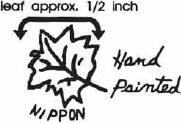
This mark is considerably larger than the original. The leaf is approx. i/2" broad.
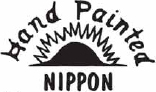
There is white infinite betwixt the torso of the sun and the lesser of the rays.
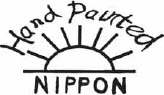
The body of the sun is an outline. The rays simply direct lines.
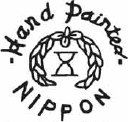
Wreath turned upside downward; an hour glass in the middle, (hour glass was never used in an quondam mark)
Wreath is closed at height; no stem on 3-leaf effigy at base of wreath.
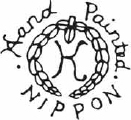
Wreath turned upside downward; letter "One thousand" in center. (K was never used in old mark).
Summary of old Nippon marks
The original marker is in two colors. The words "Hand Painted" are red; "RC" and "Nippon" are greenish. Letters R and C should be well formed and distinct. Look for the curled loop in the P in painted.
"Hand Painted" is set in a straight line. In that location is a loop in the cross bar of the letter "H"
The width of the foliage in the one-time mark is approx. l/four"broad.
The trunk of the lord's day in the old mark is solid.
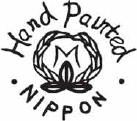
The letter of the alphabet "M" in the center. Note that the wreath is open at top.
There is a stem at the base of the 3-leaf figure at the bottom of the wreath.
Notation the decorative flourishes in the crossbar of the letter H. There are as well decorative strokes at the end of each line of the letter P.
Source: https://www.realorrepro.com/article/New-Porcelain-Marked-Nippon

Postar um comentário for "Nippon Hand Painted Oblong Serving Plate With 6 Small Dishes Art Deco Style"